What Is
Programmatic Advertising?
Programmatic advertising is the automated buying and selling of digital ad inventory using software and real-time data. It replaces manual insertion orders and negotiated placements with a process that runs on its own.
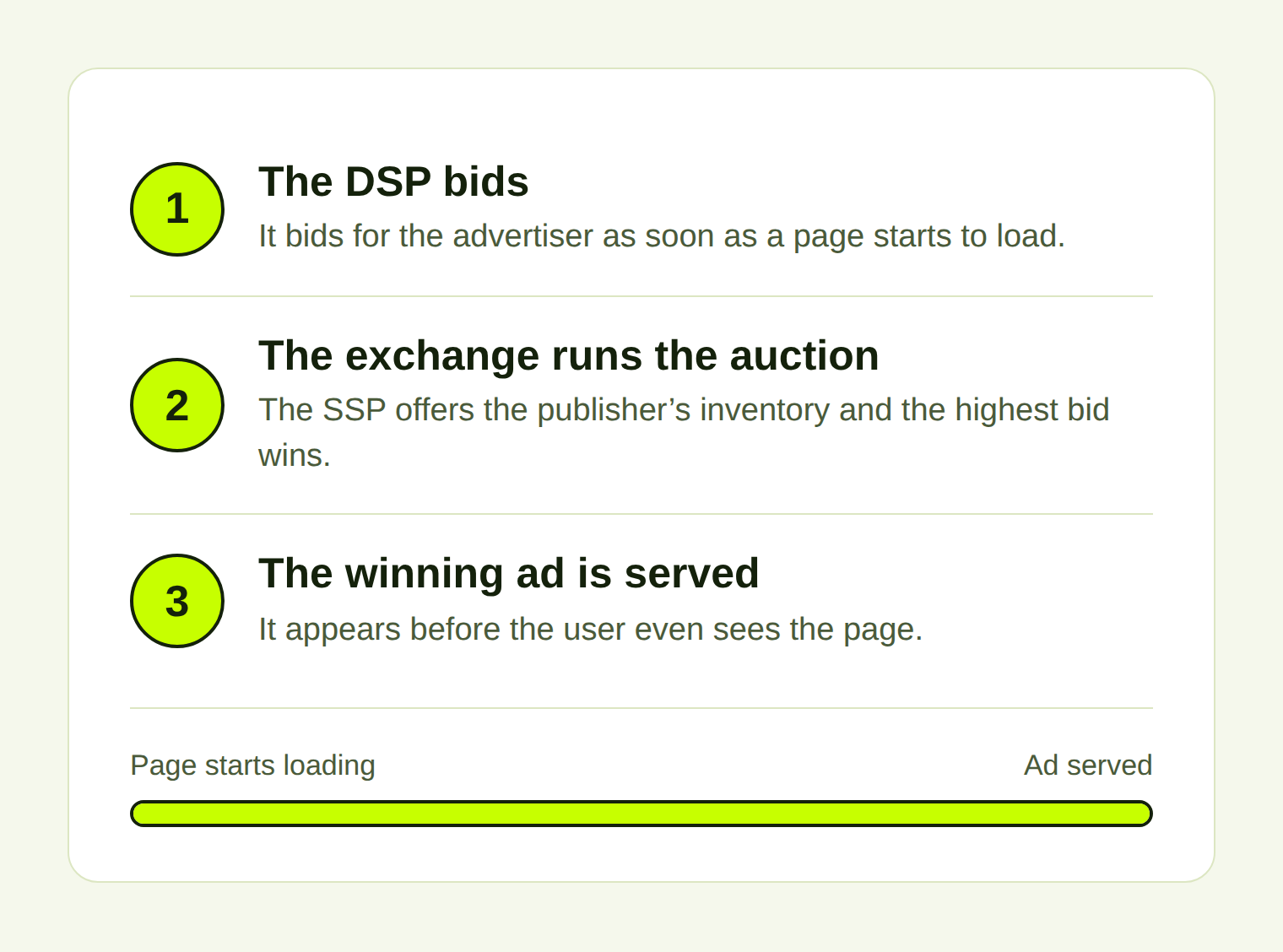
A demand-side platform (DSP) bids on behalf of an advertiser. A supply-side platform (SSP) represents the publisher’s inventory. The two connect through an ad exchange that runs an auction, typically via real-time bidding (RTB), in the milliseconds it takes a page to load. The winning ad is served before the user sees the page.
For publishers and ad networks, programmatic advertising turns unsold or manually managed inventory into a continuously optimized, competitively bid revenue stream. That only works if the platform underneath gives you direct demand connections, transparent reporting and control over your own supply chain, rather than routing everything through a single black-box pipe.
Limelight Inc.
is a White-Label oRTB platform built to power programmatic infrastructure for publisher networks
and ad networks. It is trusted by hundreds of clients and offering:
1-on-1
Decicated
Support
Unlimited
QPS
Free IVT
Tools
1. What Programmatic Advertising Actually Means
Programmatic advertising uses software to automate the buying and selling of ad space. Before it existed, media buyers had to contact publishers, negotiate prices and campaign dates, and manually manage ads through ad servers. This approach worked for a small number of deals but could not keep up with billions of daily impressions across millions of websites and apps.
Programmatic advertising automates this process by deciding in real time which ad to show each user. These decisions are based on factors such as audience data, budgets, device type and campaign performance. The buying and selling still connects advertisers and publishers, but software handles each transaction automatically.
For publisher networks, automation is only valuable when they remain in control of the rules and decisions. A platform that operates without transparency or the ability to influence its decisions limits publishers' control over their revenue and optimization.
How Programmatic Advertising Works, Step by Step
Here's what happens in the roughly 100–300 milliseconds between a user opening a page and an ad appearing on it:
A User Loads a Page Or App
The publisher's ad slot fires a request for an ad to fill it.
The SSP Packages a Bid Request
It bundles context about the impression — page content, ad size, device, user data where consent allows it — and sends it out to demand sources.
Bid Request Routing
The bid request reaches an ad exchange, which routes it to connected DSPs.
Each DSP Decides Whether and How
Much to Bid
It bundles context about the impression — page content, ad size, device, user data where consent allows it — and sends it out to demand sources.
The Winning Ad Is Served
The winning ad creative is served. It renders on the page — all before the user has finished loading it.
The Highest Eligible Bid Wins
Depending on the auction type, the winner pays either their own bid (first-price auction) or the second-highest bid plus a small increment (second-price auction).
07
Data Flows Back for Reporting and Optimization
Win rate, price and performance data feed back into both the DSP and the SSP,
so future bids and yield decisions are informed by what just happened.
Modern setups often add another step before or alongside the auction: header bidding. Using a wrapper like Prebid.js, publishers offer the same impression to multiple exchanges and demand sources simultaneously, rather than sending it through them one at a time in a waterfall.
This has become the standard approach because it increases competition for each impression, helping publishers capture more demand and avoid leaving revenue on the table.
The Building Blocks of the Programmatic Ecosystem
1. The Platforms
- Demand-Side Platform (DSP): Software that lets advertisers and their agencies buy inventory across many publishers and exchanges from one interface, bidding automatically based on targeting and budget rules.
- Supply-Side Platform (SSP): The publisher-side equivalent — it manages a publisher's or network's inventory, connects it to multiple demand sources, and runs the auction logic that decides which bid wins.
- Ad Exchange:
The marketplace layer where SSPs and DSPs actually transact — think of it as the trading floor that connects supply and demand in real time.
2. How the auction works
- Real-Time Bidding (RTB) And OpenRTB (oRTB): RTB is the auction mechanism itself. openRTB is the industry-standard protocol that lets SSPs and DSPs from different vendors actually talk to each other using a shared bid request/response format, instead of every platform needing a custom integration with every other one.
- First-Price Auction: An auction model where the winning bidder pays exactly what they bid. Because buyers can no longer count on paying less than their bid, many DSPs use bid shading to adjust bids towards the lowest price likely to win. It is now the standard model in most programmatic auctions.
- Header Bidding: A technique that lets a publisher offer inventory to several demand sources at the same time, before the request reaches the ad server, instead of one after another in a waterfall. More competition for each impression typically lifts yield and gives the publisher clearer visibility of bids. Prebid is the most widely used open-source standard for it.
3. Deals and pricing
- Private Marketplaces (PMPs) And Deals: Not all programmatic buying is open-auction. In a private marketplace, a publisher invites specific buyers to bid on reserved inventory, often at a negotiated floor price. Programmatic guaranteed deals go further, fixing both price and volume in advance while still trafficking and serving the ad programmatically.
- Price Floors: The minimum price a publisher or network will accept for an impression. Bids below the floor are rejected, which protects revenue, but a floor set too high can reduce fill rate. Floors can be fixed or dynamic, adjusting automatically to signals such as ad format, geography or demand source.
4. Deals and pricing
- Supply Path — Ads.txt And Sellers.json: As inventory can be resold through multiple intermediaries before it reaches an advertiser, ads.txt and sellers.json are the files that let a publisher declare who's authorized to sell their inventory, and let a buyer verify who they're actually buying from. Together they're the main defense against ad fraud and unauthorized resale in the programmatic supply chain.
- Queries Per Second (QPS): The number of bid requests a platform sends or receives each second. Every SSP and DSP has a QPS limit, and sending requests to bidders unlikely to respond wastes capacity and adds cost. Managing QPS well means routing each demand partner the traffic they are most likely to value, which cuts infrastructure costs without losing revenue.
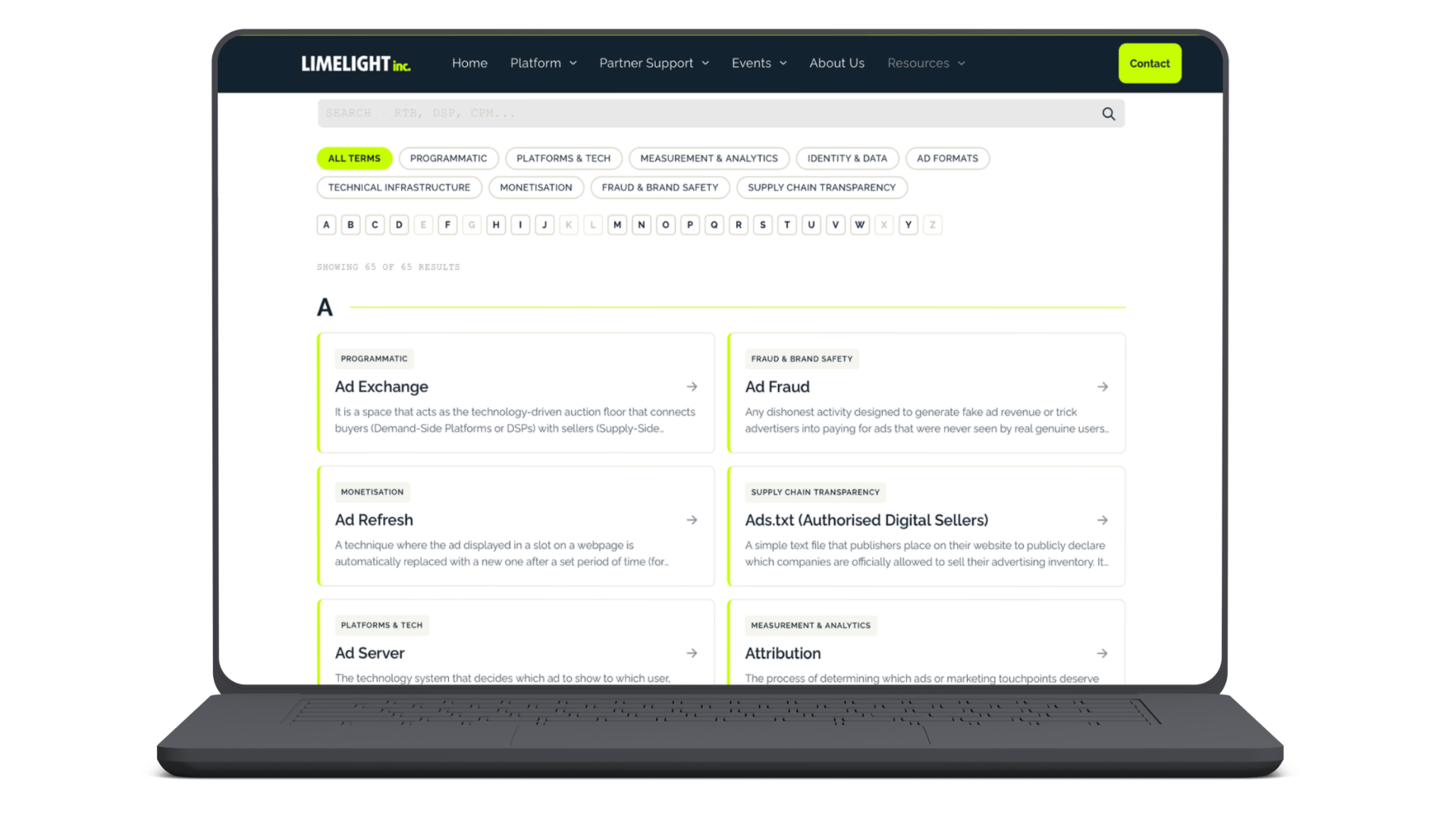
Want to Learn More About Programmatic Advertising?
Explore our Programmatic Glossary and get up to speed
on the key terms, concepts and technologies.
Open Auction vs. Private Deals:
The Main Ways Programmatic Inventory Trades
Open Auction (RTB)
Any connected buyer can bid on the impression; highest eligible bid wins. Maximum competition, least control over who buys.
Private Marketplace
Invite-only auction among selected buyers, usually with a negotiated floor price. More control, still auction-based.
Preferred Deals
A fixed price is agreed in advance, but the buyer isn't obligated to purchase — first right of refusal before the impression goes to open auction.
Programmatic Guaranteed
Price and volume are both fixed in advance, closest to a traditional direct-sold deal, but still trafficked and measured programmatically.
What to Check Before You Adopt a Programmatic Platform
Does the platform use
standard openRTB so it can connect to demand you already have relationships with, or does it lock you into a closed set of buyers?
Can you see bid-level data, such as winning price, buyer and auction type, or only aggregated revenue?
Do you retain
control of your own ads.txt and sellers.json, or is that managed for you without visibility?
Does it integrate with
header bidding
and your
existing ad server, or require a rebuild?
Can automation rules be
configured to your own KPIs, or only the vendor's defaults?
Is there a human team
behind the automation when something breaks?
How Limelight Inc. Puts Programmatic Advertising to Work for Publisher Networks
Understanding the mechanics is one thing. Running them profitably, at scale, across an entire network of publishers, is another.
Limelight Inc.'s
platform is built specifically to operate the programmatic stack described above on a publisher network's behalf — without asking the network to give up visibility or control over it. That includes:
Direct oRTB connections to SSPs and DSPs,
plus support for private marketplaces and curated deals — so a network controls exactly who bids on its inventory and on what terms.
Full supply path management,
including tools to configure ads.txt and sellers.json, keeping supply-chain transparency in the network's own hands.
Multiple supply integration paths, header bidding, oRTB endpoints, and VAST/JavaScript tags — alongside existing Google Ad Manager and Prebid.js setups, so networks aren't forced into a rebuild.
The Adaptive Rules Center (ARC),
which automates real-time decisions across fill rate, eCPM and revenue thresholds, running the optimization layer of the RTB auction continuously rather than on a fixed schedule.
Bid-level analytics with API access,
so networks can see exactly what won, what lost and why — not just a top-line revenue number.
Unlimited, uncapped QPS across web, mobile web, in-app and CTV, with global data centers built for the volume a network-level auction actually generates.
A dedicated Client Success team
for the parts of the supply chain that automation can flag but a person needs to resolve.
The Proof Points
[CTV PUBLISHER NETWORK]
SCALING PERFORMANCE UNDER QPS LIMITS
+100%
REVENUE INCREASE
+70%
EFFICIENCY IMPROVEMENT
ARC amplified high-performing demand automatically while staying within
set QPS limits - combining partner strategy with automation.
[APAC AD EXCHANGE]
3X REVENUE IN ONE DAY
+289%
REVENUE INCREASE
10X
FILL RATE IMPROVEMENT
By simply implementing two account wide automation rules, the partner unlocked faster, data-driven decision making.
[PERFORMANCE-BASED SSP]
OPTIMISING VIDEO MONETISATION
X4
SUCCESS RATE
REVENUE
TRAFFIC STABILITY
HEALTHIER AUCTION ENVIRONMENT
Automated creative filtering eliminated failed impressions and
stabilised the auction.
[DISPLAY AND IN-APP]
TRANSFORMING PARTNER PERFORMANCE
+100%
REVENUE INCREASE
19X
eCPM INCREASE
Automated optimisation with Granular QPS and Demand Field Lists within ARC improved efficiency, control, and scalability.
Independent press coverage of ARC's launch reported early tests showing revenue increases exceeding 300% and fill rate improvements over 900%.
"The Platform consistently demonstrates a deep understanding of technological concepts and an unwavering commitment to delivering high-quality results, helping us to reach our partner's KPIs in scale. The high level service we get by the customer success team is unparallel."
Lior Nir,
Ad Operation Manager at OMS
FAQs
Is Programmatic Advertising The Same As Real-Time Bidding?
No. RTB is one method of programmatic buying, specifically the open-auction, impression-by-impression kind. Programmatic advertising also includes private marketplaces, preferred deals and programmatic guaranteed deals. All of them are automated, but not all are auction-based.
What's The Difference Between A DSP And An SSP?
A DSP represents the buyer. It’s how advertisers and agencies bid across many publishers from one place. An SSP represents the seller. It’s how a publisher or network offers inventory to many buyers at once. Programmatic advertising is what happens when the two connect through an exchange.
Does Programmatic Advertising Replace Direct Ad Sales?
Not necessarily. Programmatic guaranteed and preferred deals let publishers keep the pricing certainty of a direct deal while still trafficking it through programmatic infrastructure. Most publisher networks run a mix: direct and programmatic-guaranteed deals for premium inventory, open auction and PMPs for the rest.
How Does Limelight Inc. Fit Into A Publisher Network's Existing Programmatic Setup?
Limelight Inc. is designed to work alongside a network's existing Google Ad Manager and Prebid.js setup rather than replace it, adding direct demand connections, automated optimization through the Adaptive Rules Center, and full supply-chain visibility on top of what's already running.
See How Direct Demand, Supply Path Control and Real-Time Optimization
Can Benefit Your Inventory
Get in touch with Limelight Inc to walk through your current stack.